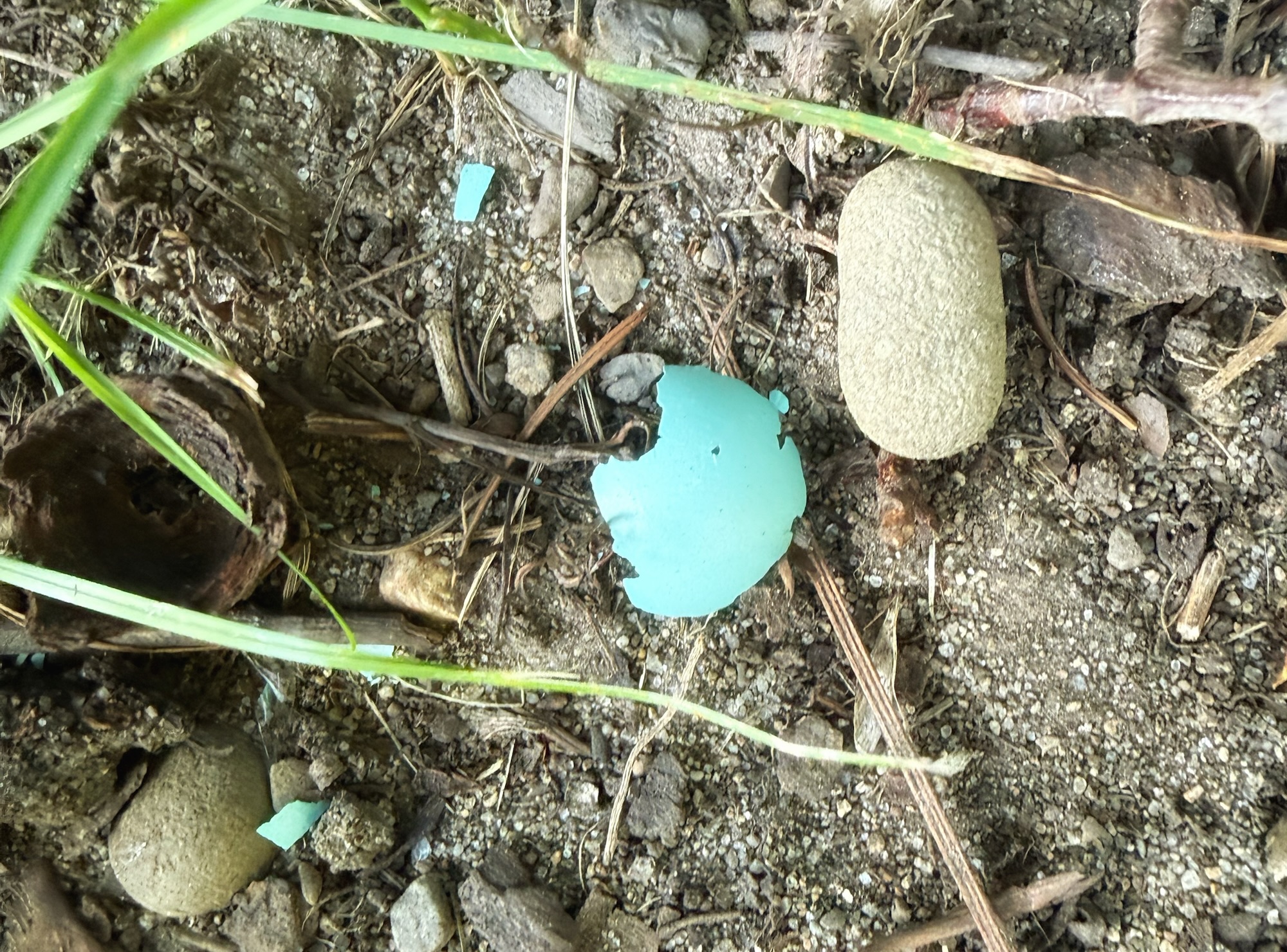
I almost stepped over it.
It was just a piece of broken shell lying in the dirt, surrounded by pine needles, stones, and the debris that accumulates wherever nature is left to itself.
But then I saw the color.
That impossible blue against the earth.
And I stopped.
I wondered how many beautiful things we miss because we have already decided that broken means ruined.

There’s something almost absurdly beautiful about the broken turquoise shell lying in dirt and pine needles. It’s not beautiful despite being broken. The brokenness is what makes it visually arresting. The jagged edges, the pieces scattered around it, the contrast between that almost luminous blue and the ordinary earth.
And then there are those little intact forms beside it—whole, quiet, almost egg-like things. So you have this natural juxtaposition of whole and broken, becoming and becoming-undone.
We like the unbroken bowl.
The finished painting.
The relationship that works.
The body that doesn’t betray us.
The life that follows the plan.
We tend to look at the broken thing and immediately think:
This needs to be fixed.

But what if brokenness isn’t always a failure of the thing?
What if sometimes the breaking is part of what reveals it?
A shell has to break for something to emerge from it. A seed has to split open. A fallen branch becomes habitat. A decaying thing feeds something else. Even the pieces of something that can no longer be made whole become part of the landscape.
And maybe people aren’t so different.
Perhaps we spend too much of our lives trying to return ourselves to a version of whole that never really existed.
A version only held in memory.
Maybe this is true of our memories, too.
A fragment here. A face there. The feeling of sunlight through a particular window. The sound of someone’s voice. A sentence we can’t quite remember but somehow remember how it made us feel.

We take these fragments and build a story around them.
And sometimes, without realizing it, we mistake the story for the thing itself.
We remember childhood as a place we could once return to. A relationship as something that was once whole. A version of ourselves we imagine we might somehow find again.
But perhaps what we’re remembering was never quite as whole as we believe.
What happens when we stop trying to put the memories back together?
Because maybe the fragments don’t need to reconstruct the whole.
Maybe a broken memory can simply be a piece of what was—valuable without being complete, beautiful without being entirely accurate.
The turquoise eggshell isn’t beautiful because you can reconstruct the object it once belonged to.
It’s beautiful as a fragment.
Some things don’t need to be made whole to be worthy of being held.
