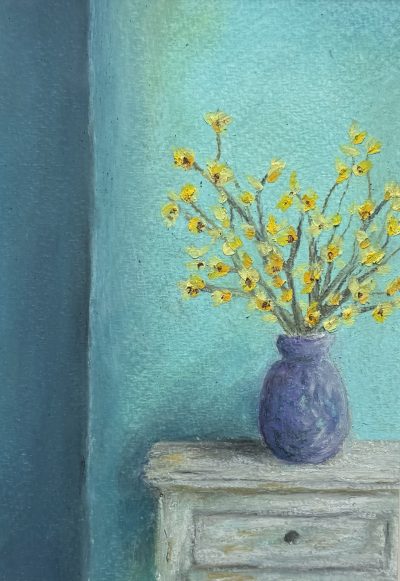
I’ve been drawing more lately, while my creative writing—whether crafting new meditations or writing essays—has taken a back seat.

This shift happens from time to time, usually when I’m stressed and my focus settles on one particular creative pursuit. Eventually, I get bored. I need a change, a different way to express the inexpressible.
This past August, I found that change quite serendipitously.
I needed to color something in at work and remembered that I’d purchased a set of oil pastels the previous year, after taking a mixed media art class. I dug them out and decided to play around with a few pencil sketches I’d made in a sketchbook.
I was instantly hooked.
Within my first two weeks, I’d completed five or six paintings.
You Don’t Have to Sit Still to Find Stillness
What surprised me most wasn’t how much I enjoyed working with the medium, but how freely I approached it. At no point was I particularly self-conscious about what I was doing or how I was doing it. With other mediums, I might start out in the zone, only to lose that freedom somewhere along the way. I begin second-guessing my technique, questioning my skill, wondering whether I’m doing it right.
With oil pastels, I simply get lost in the creative process.
I blend colors. I follow an impulse. I make marks on paper and see where they take me. I’m not thinking about whether I’m good enough or whether the finished piece will be something worth sharing. I’m just there, immersed in the act of making something that didn’t exist before.
And somewhere in that process, something shifts.

I let go without trying to let go. I become absorbed without making concentration another thing to accomplish. I find myself present, not because I’ve worked to quiet my mind, but because my attention has naturally settled into what I’m doing.
Isn’t that, in its own way, meditation?
The practice of letting go
We often associate meditation with sitting still, closing our eyes, and following the breath. And there is tremendous value in that practice. But meditation doesn’t have to look the same for everyone, or even look the same for us throughout our lives.
Sometimes it’s a mindful walk, noticing the way light falls through the trees. Sometimes it’s listening to music that moves us so deeply that, for a moment, we forget everything else. And sometimes it’s putting a brush, pencil, or oil pastel to paper and allowing ourselves to follow wherever the process leads.
Creative expression can become a form of meditation when we give ourselves permission to be present with it.
We aren’t necessarily trying to achieve a particular state of mind. We aren’t trying to fix ourselves or force ourselves into calm. We’re simply engaging with what’s in front of us, allowing our attention to settle and our inner commentary to soften.
For me, there’s also something therapeutic about this process.

Not every feeling needs to be put into words. Not every experience can be neatly explained or understood. Sometimes we carry things that have no clear language, emotions that don’t fit into tidy categories, or experiences that we haven’t quite figured out how to articulate.
Art gives me another way to meet those things.
The colors I choose, the marks I make, and the way a piece unfolds become a kind of reflection—not necessarily a conscious attempt to communicate something, but an expression of how I see the world and how I move through it.
I don’t always know what I’m expressing when I begin. Sometimes I don’t know until much later, and sometimes there isn’t anything to figure out at all.
The act of creating is enough.
Finding our own doorway
I think we sometimes become so focused on what a practice is supposed to look like that we overlook the ways it naturally appears in our lives.
We sit down to meditate and find our minds wandering, then assume we’re doing it wrong. We pick up a creative pursuit and become preoccupied with technique, comparison, or the finished product. We turn something that could offer freedom into another measure of our own performance.
I’ve certainly done this.
But what happens when we let ourselves simply explore? When we follow curiosity instead of expectation? When we allow ourselves to make something imperfect, unfinished, or entirely our own?
Perhaps we find a little room to breathe.

Perhaps we discover that stillness isn’t always the absence of movement, and presence doesn’t require us to be perfectly calm. Sometimes it comes through the movement of our hands, the rhythm of a repeated action, or the simple pleasure of watching colors meet on paper.
There is no single doorway into the present moment.
For some of us, it’s found on a meditation cushion. For others, it might be in a garden, a kitchen, a notebook, or a studio scattered with art supplies. And sometimes the doorway changes. What once nourished us may take a back seat while something else calls for our attention.
That doesn’t mean we’ve lost our way.
Maybe we’re simply finding another way in.
For me, creating art has become a place where I can release the need to get things right and reconnect with something more essential. I can be curious. I can be imperfect. I can allow something to emerge without knowing exactly where it’s going.
And in doing so, I find myself returning to the present moment—and to a part of myself that doesn’t need to be explained or improved.

The part that simply wants to create.
Maybe meditation isn’t always about sitting still and looking inward.
Maybe sometimes it’s about picking up a pastel, making the first mark, and allowing yourself to see what happens next.
Maybe it’s about finding the freedom to be fully here, exactly as you are.
And maybe that’s where you meet yourself again.
If you feel called to explore your unique creative stlye, please take a few moments to setlle in and listen to this genlte guided meditaiton.
In this calming meditation, you will be guided to explore your creativity through visualization. This will help your natural creative spirit express itself freely. Carry the essence of this practice into every task and seek opportunities to use your creativity and passion. By doing so, you will enhance not only your creations but also the experiences of those who encounter them.
Music: Immersion by Maura ten Hoopen is crafted to foster the exploration of the subconscious. Allow this music to enhance your journey within.